
We identify the cause of cracked bricks, crumbling mortar, loose masonry, and water entry before the damage spreads.
Visible masonry damage may begin with a small crack, a worn mortar joint, or one damaged brick. Left unresolved, however, moisture and repeated freeze-thaw cycles can cause the affected area to deteriorate further.
We provide professional brickwork repair for homes, multi-residential buildings, commercial properties, and institutional buildings across Montréal and surrounding areas. Our work begins with a careful assessment of the masonry so we can identify what caused the damage and recommend the appropriate repair.
We do not approach every wall with the same repair method. We evaluate the condition, explain what we find, and prepare a clear scope based on what the masonry actually requires.
Send us photos of the damaged area or contact us to arrange an on-site visit.
Mortar joints help protect the masonry assembly while allowing the wall to manage moisture. When the joints crack, erode, or separate from the bricks, water can enter vulnerable areas. During Québec winters, moisture inside damaged masonry may freeze and expand. Repeated freezing and thawing can contribute to:
Timely brickwork repair helps limit moisture entry and reduce the risk of continued deterioration. We review more than the damaged brick alone. Where relevant, we also consider surrounding joints, sills, lintels, caulking, flashing, and other details that may be contributing to the problem.
When the bricks remain serviceable but the mortar joints are cracked, loose, recessed, or missing, repointing may be the appropriate solution.
We remove deteriorated mortar to a suitable depth and install new mortar selected for compatibility with the existing masonry.
Proper repointing can help:
Repointing is often an important part of brick mortar restoration, especially on older façades where the existing bricks can be preserved.
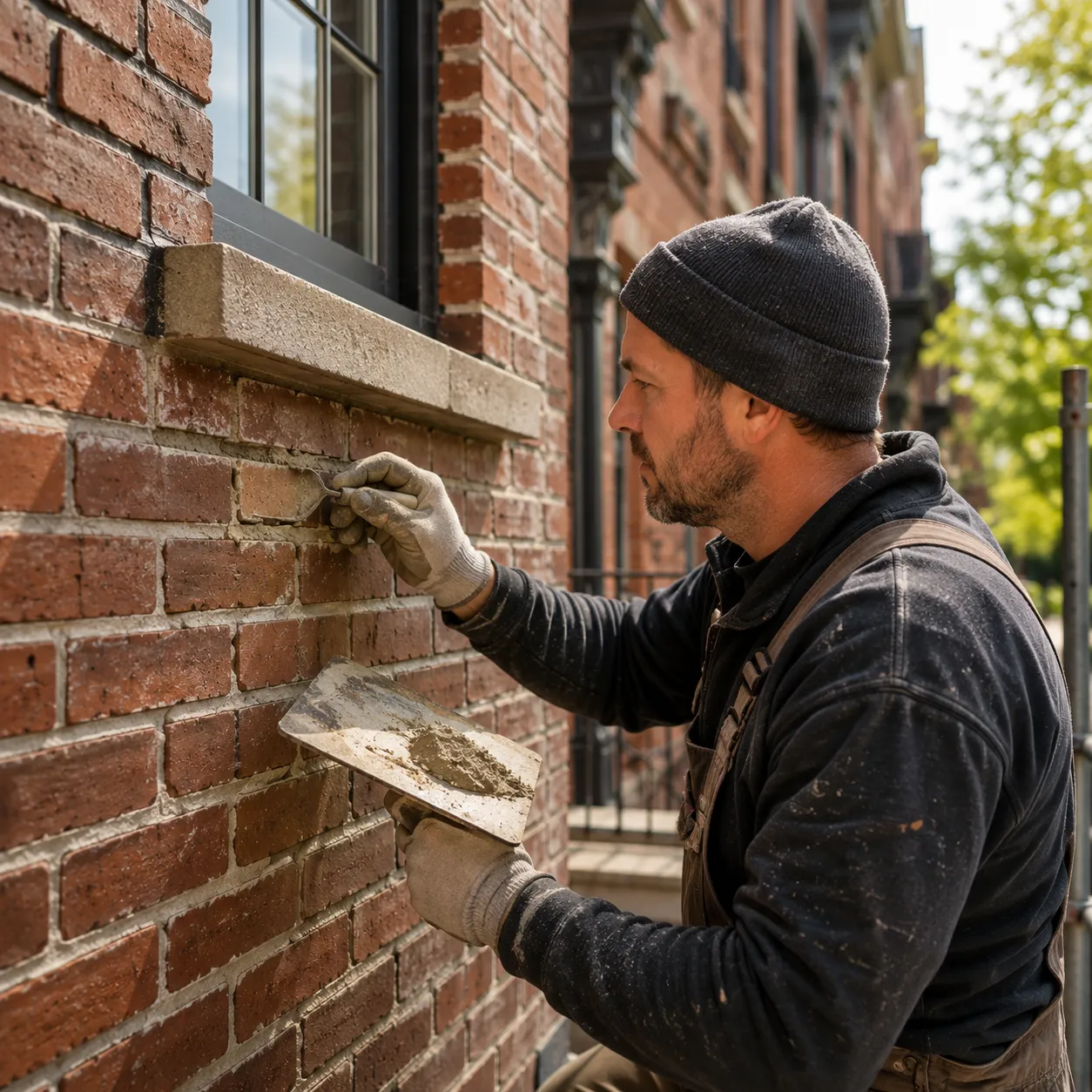
Some bricks become too cracked, broken, loose, or spalled to remain in place.
We remove damaged units carefully and replace them without disturbing sound masonry unnecessarily. When selecting replacement bricks, we consider:
Selective replacement allows us to address damaged areas while preserving as much original brickwork as possible.
Some cracks remain limited to the mortar joints. Others extend through bricks or appear alongside bulging, separation, or visible movement. When movement is involved, filling the crack alone may not provide a lasting solution.
We assess the surrounding masonry and determine whether the repair may require:
Our focus is to repair the masonry in a way that addresses the visible condition and the factors contributing to it.
We understand why property owners may hesitate before starting masonry work. It can be difficult to know how much of the wall needs attention, which method is appropriate, or whether a temporary patch is being proposed. Our assessments and estimates are designed to provide clarity.
We explain:
This helps you understand the work before making a decision.
We do not recommend rebuilding sound masonry unnecessarily, and we do not rely on surface patching when the condition requires a more complete repair. We match the scope to the building and the actual condition of the brickwork.
Older walls often show several types of deterioration at once. The same façade may have worn joints, cracked bricks, mismatched patches, and moisture-related damage.
In these cases, a coordinated brick and mortar restoration plan may combine:
This approach allows us to restore the affected area as a complete assembly rather than treating each defect in isolation.We provide a defined scope for the work we recommend, whether the project requires repointing, selective replacement, crack correction, or localized rebuilding.
A successful masonry repair should restore performance while blending as naturally as possible with the existing façade.
Matching involves more than choosing a similar-looking brick. We also consider:
Mortar compatibility is particularly important. Mortar that is too hard or poorly suited to the original masonry can affect how the wall handles moisture and movement.
For older and character properties, we take additional care to respect the existing materials and architectural appearance. Our approach prioritizes repair and preservation wherever the surrounding masonry remains serviceable.
The result should feel integrated with the building—not like an obvious patch.
We provide masonry repair for:
For homeowners, the priority is often to stop deterioration, prevent moisture problems, and protect property value.
For property managers, condominium boards, and commercial owners, the work may also need to account for access, occupant safety, scheduling, documentation, and phased maintenance.
We adapt the repair process to the property while maintaining the same core approach: assess the condition, define the work clearly, and use materials suited to the existing masonry.
A visible crack does not always mean that an entire wall must be rebuilt. It should not automatically be treated as a surface problem either.
We assess the visible damage, surrounding mortar joints, openings, wall alignment, and signs of moisture before recommending any work. This allows us to distinguish between routine masonry maintenance and conditions that require more involved repair or stabilization.
Our goal is to correct the source of the deterioration wherever possible—not simply cover the visible symptom.
Some conditions develop gradually. Others may indicate active movement or a safety concern. An assessment helps establish the urgency and the most appropriate next step.
Crumbling or recessed mortar joints
Stair-step cracks
Vertical cracks
Loose or shifting bricks
Flaking brick faces
Spalling brick
Bulging sections of a wall
Gaps around windows or doors
Water staining
Interior moisture near an exterior masonry wall
Previous repairs pulling away
Pieces of mortar or brick on the ground
Include a close-up image and a wider photo of the full wall. We can review the visible condition and help determine whether an on-site assessment is needed.
We recommend arranging an assessment when visible changes appear, especially after winter or periods of heavy rain.
An inspection may also be appropriate when:
Early assessment may allow us to repair a smaller area before the damage spreads into adjacent masonry. Loose bricks, falling masonry, significant bulging, or rapidly changing cracks should be treated as higher-priority concerns. Keep people away from the affected area and contact us promptly.
We provide brickwork repair, repointing, brick replacement, and masonry restoration in:
Our local experience helps us account for the moisture exposure, winter conditions, and freeze-thaw cycles that affect masonry across Québec. We serve residential, commercial, and institutional property owners with repair plans tailored to the building, the materials, and the extent of the damage.
Cracked bricks, failing mortar, loose masonry, and water staining are signs worth investigating.
We assess the affected area, explain the repair options, and prepare a clear scope for the work your property requires. From repointing and selective brick replacement to crack correction and localized rebuilding, we focus on restoring the masonry with compatible materials and a method suited to the wall.
Send us photos or schedule an on-site visit to discuss your brickwork repair needs.
Brique Maçonnerie
RBQ licence: 5743-4037-01
Email: Info@emcorpinc.ca
Phone: (819) 743-8142
Website: briquemaconnerie.ca/en/